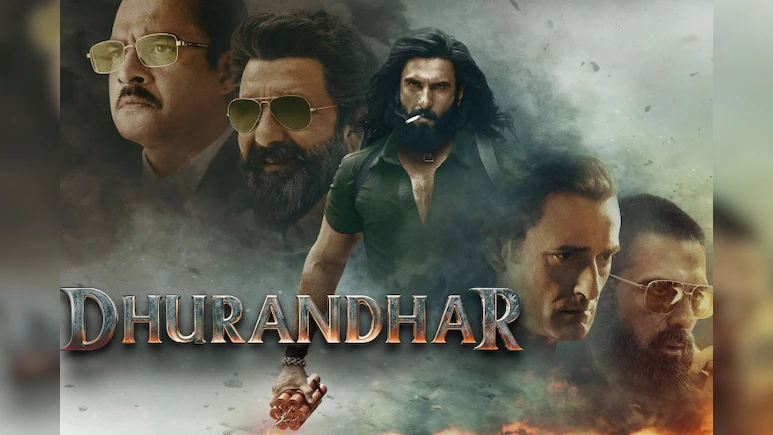
Ranveer Singh returns to seek revenge in the first-look teaser of Dhurandhar 2, dropped by the makers on Tuesday. The one-minute-12-second-long video offers a glimpse into Ranveer taking the reins in Lyari. The clip interweaves scenes from the original film, highlighting the continuity of the story.
Released on December 5, Dhurandhar arrives as one of the most ambitious Hindi films of the year, driven by a powerful narrative and an impressive ensemble cast. The film brings together some of the most accomplished performers in Indian cinema, with Ranveer Singh leading the charge alongside Akshaye Khanna, Sanjay Dutt, Arjun Rampal, R. Madhavan, and young actor Sara Arjun in pivotal roles.
At its core, Dhurandhar is a layered, character-driven film that explores themes of power, ambition, moral conflict, and the consequences of choices made under pressure. The narrative unfolds in a tense and atmospheric setting, where every character operates within shades of grey rather than clear definitions of right and wrong. This moral ambiguity gives the film its emotional weight and intellectual depth.
Ranveer Singh delivers one of his most restrained yet intense performances, stepping away from flamboyance to portray a character shaped by inner conflict and external forces. His portrayal anchors the film, providing emotional continuity amid shifting alliances and rising tensions. Ranveer’s character is not positioned as a conventional hero, but as a man navigating circumstances that constantly test his ethics and resilience.
Akshaye Khanna brings his signature subtlety to the screen, playing a role marked by intelligence, silence, and calculated intent. His performance adds a psychological dimension to the story, making his character both compelling and unpredictable. Sanjay Dutt, meanwhile, commands attention with a role that draws upon authority, experience, and underlying vulnerability. His presence lends gravitas to the narrative, especially in moments where power dynamics come into sharp focus.
Arjun Rampal’s character introduces an element of quiet aggression and emotional restraint, contributing to the film’s tense atmosphere. His interactions with the other leads are marked by conflict, unspoken rivalries, and shifting loyalties. R. Madhavan, known for his nuanced performances, plays a role that blends intellect with emotion, serving as a crucial narrative pivot in the film. His character challenges other protagonists not just physically, but ideologically.
Sara Arjun stands out as an emotional anchor in the story. Despite her young age, she delivers a mature performance that adds human sensitivity to an otherwise intense and hardened world. Her character plays a key role in revealing the personal costs of ambition and power struggles.
Visually, Dhurandhar maintains a grounded and realistic aesthetic. The cinematography uses muted tones and carefully composed frames to heighten the film’s seriousness and sense of unease. The background score is restrained yet effective, amplifying tension without overpowering the narrative. Action sequences, where present, are realistic and purposeful, focusing more on consequence than spectacle.
What sets Dhurandhar apart is its ensemble approach. Rather than centering solely on one protagonist, the film allows each character space to evolve, creating a narrative driven by interactions, conflicts, and shifting power equations. This balance ensures that no single performance overshadows the story, making the film feel cohesive despite its large cast.
Overall, Dhurandhar is not just a star-driven release but a serious cinematic effort that prioritizes storytelling and character depth. It appeals to audiences who appreciate intense dramas with strong performances and moral complexity. With its December 5 release, the film positions itself as a thoughtful and engaging addition to contemporary Hindi cinema—one that aims to resonate beyond box-office numbers and linger in audience conversations.
Released on December 5, Dhurandhar emerges as one of the most ambitious and discussion-worthy Hindi films of recent times. With a formidable ensemble cast that includes Ranveer Singh, Akshaye Khanna, Sanjay Dutt, Arjun Rampal, R. Madhavan, and Sara Arjun, the film positions itself as a layered, character-driven drama that explores power, ambition, moral compromise, and the human cost of conflict.
Rather than relying solely on star power or spectacle, Dhurandhar attempts something more challenging: a cinematic experience rooted in complex personalities, shifting loyalties, and ethical dilemmas that refuse easy answers. It is a film that demands attention, patience, and emotional engagement from its audience.
A December 5 release places Dhurandhar in a strategically important window. Historically, year-end releases in Bollywood often aim to balance commercial potential with critical acclaim. These films tend to target mature audiences—viewers who seek depth, performance-oriented storytelling, and narratives that linger beyond the theatre.

Dhurandhar fits squarely within this tradition. It does not chase mass spectacle or festival-style extravagance. Instead, it positions itself as a serious cinematic offering—one designed to spark conversation, debate, and analysis long after the closing credits roll.
At the center of Dhurandhar is Ranveer Singh, delivering a performance that deliberately moves away from his more flamboyant on-screen persona. Known for his boundless energy and transformational roles, Ranveer adopts a more restrained, internalized style here.
His character is defined less by loud declarations and more by internal conflict. The performance relies on silence, subtle expressions, and moral hesitation. Ranveer portrays a man caught between ambition and conscience, strength and vulnerability. This duality makes his character deeply human and, at times, unsettling.
Rather than presenting a conventional hero, Dhurandhar places Ranveer in morally ambiguous territory. His decisions are not always admirable, nor are they entirely condemnable. This refusal to simplify his character elevates the narrative and challenges audience expectations.
Akshaye Khanna’s role in Dhurandhar exemplifies the power of understatement. Known for his cerebral performances, Akshaye once again proves that silence can be as impactful as dialogue.
His character operates with calculated precision. Every glance, pause, and measured line delivery suggests layers of strategy beneath the surface. Akshaye’s performance adds a psychological edge to the film, making his character unpredictable and quietly intimidating.
In many ways, he represents the intellectual force within the story—the mind that observes, evaluates, and strikes only when necessary. His presence enhances the film’s tension, especially in scenes where power shifts occur without overt confrontation.
Sanjay Dutt brings a commanding presence to Dhurandhar, drawing on decades of cinematic experience. His character is steeped in authority—someone who has seen power rise and fall, and who understands its cost.
Unlike roles that rely solely on physical dominance, Sanjay Dutt’s performance here is layered with emotional fatigue and unspoken regret. There is a sense that his character carries the weight of past decisions, making him both formidable and vulnerable.
This complexity prevents the character from becoming a stereotypical strongman. Instead, he feels real—shaped by history, loss, and survival.
Ultimately, Dhurandhar is more than a star-studded release. It is a thoughtful, performance-driven film that explores the complexities of power, ambition, and human morality. With its December 5 release, it positions itself as a significant cinematic statement—one that values depth over convenience and conversation over instant gratification.
Whether it becomes a commercial juggernaut or a critical favorite, Dhurandhar has already succeeded in one crucial respect: it invites reflection. And in an era of fleeting entertainment, that alone makes it worth watching.